

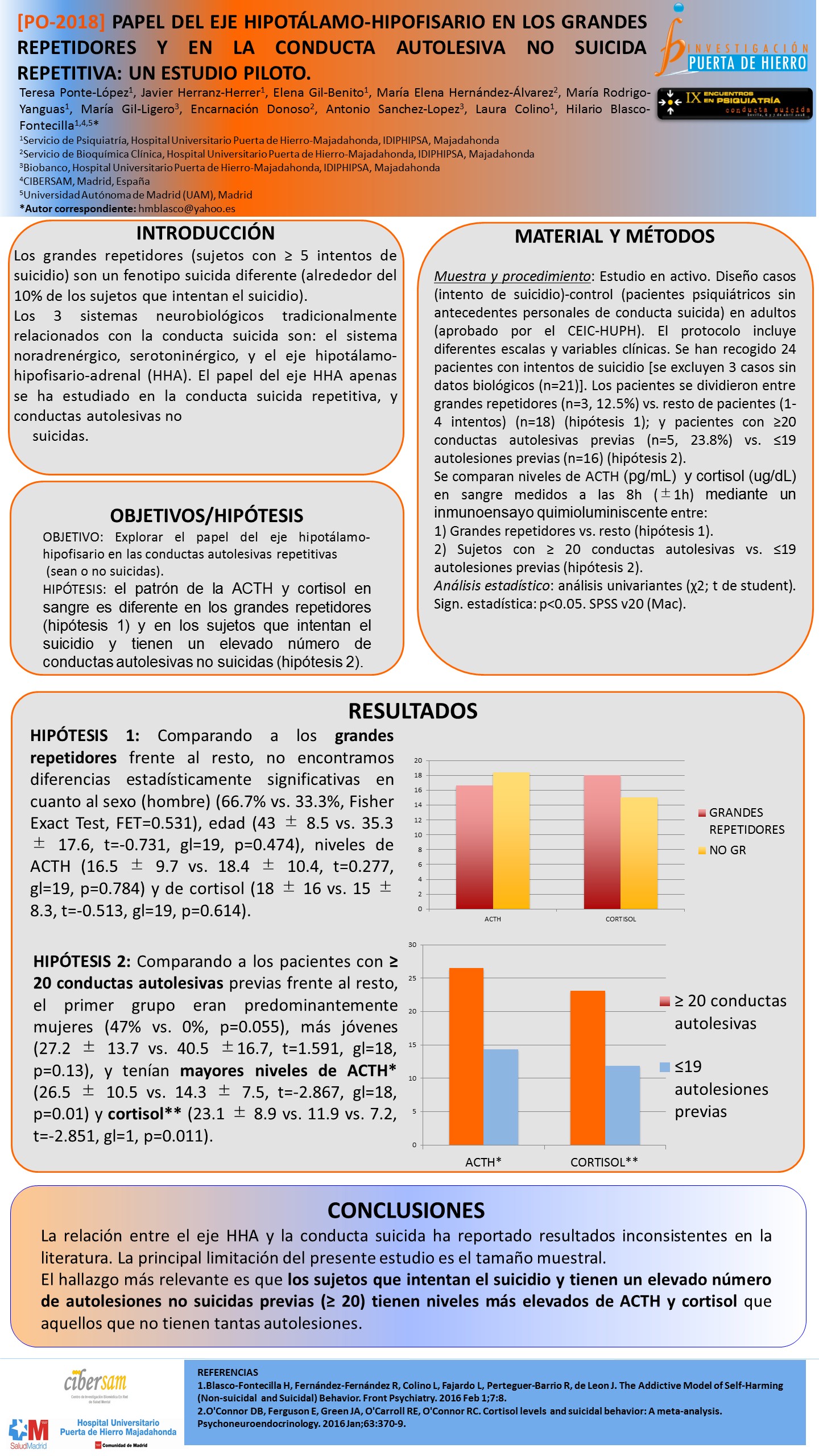
Papel del eje hipotálamo-hipofisario en los grandes repetidores y en la conducta autolesiva no suicida repetitiva: un estudio piloto.
Bibliografía
Blasco-Fontecilla H, Artieda-Urrutia P, Berenguer-Elias N, Garcia-Vega JM, Fernandez-Rodriguez M, Rodriguez-Lomas C, Gonzalez-Villalobos I, Iruela-Cuadrado L, de Leon J. Are major repeater patients addicted to suicidal behavior? Adicciones. 2014;26(4):321-33.
Blasco-Fontecilla H, Fernández-Fernández R, Colino L, Fajardo L, Perteguer-Barrio R, de Leon J. The Addictive Model of Self-Harming (Non-suicidal and Suicidal) Behavior. Front Psychiatry. 2016 Feb 1;7:8.
Blasco-Fontecilla H, Jaussent I, Olié E, Béziat S, Guillaume S, Artieda-Urrutia P, Baca-Garcia E, de Leon J, Courtet P. A cross-sectional study of major repeaters: a distinct phenotype of suicidal behavior. Prim Care Companion CNS Disord. 2014 Aug 7;16(4).
Lindqvist D, Isaksson A, Träskman-Bendz L, Brundin L. Salivary cortisol and suicidal behavior--a follow-up study. Psychoneuroendocrinology. 2008 Sep;33(8):1061-8.
Melhem NM, Keilp JG, Porta G, Oquendo MA, Burke A, Stanley B, Cooper TB, Mann JJ, Brent DA. Blunted HPA Axis