

Esketamine, a new treatment for resistant depression: a systematic review of the literature FINALISTA TMG
Introduction
According to the World Health Organization, more than 300 million people of all
ages suffer from depression all over the world. This is associated with high morbidity being considered as the main cause of the total number of years lost due to disability as well as an excess of mortality [1,2].
Treatments focused on monoaminergic interventions are ineffective in a large proportion of patients.
The strong antidepressant effects of (R, S) -ketamine are among the most important discoveries in mood research for the past half century. The off-label use of (R, S) -ketamine, has become especially popular in USA. On March 5, 2019, the Food and Drug Administration approved an (S) -ketamine nasal spray for use in treatment-resistant depression, and on December 19, 2019 was approved in Europe.
However, despite its potential for benefit, there are several concerns about the efficacy of (S) -ketamine nasal spray.
Objectives
Review the literature on the antidepressant mechanisms of action of ketamine and describe the efficacy, safety, and tolerability of R-S ketamine for patients with treatment-resistant depression.
Methods
Systematic review according to the PRISMA standards in PubMed, Web of Science Collection, Medline, Current Contents Connect and Mendeley of clinical trials, meta-analyzes and reviews published until February 2020.
A search was carried out in the databases of PUBMED, SCOPUS and EMBASE introducing the terms “Esketamine, esketamine hydrochloride, ketanest, Spravato, Ketamine, Depression, Depressive Illness, Mental Depression “and their combinations in February 2020.
The search was restricted to clinical trials, meta-analyzes and literature reviews without limits in the year of publication. No publications were included whose original language was not
Spanish or English, as well as letters to the editor and case series.
Results
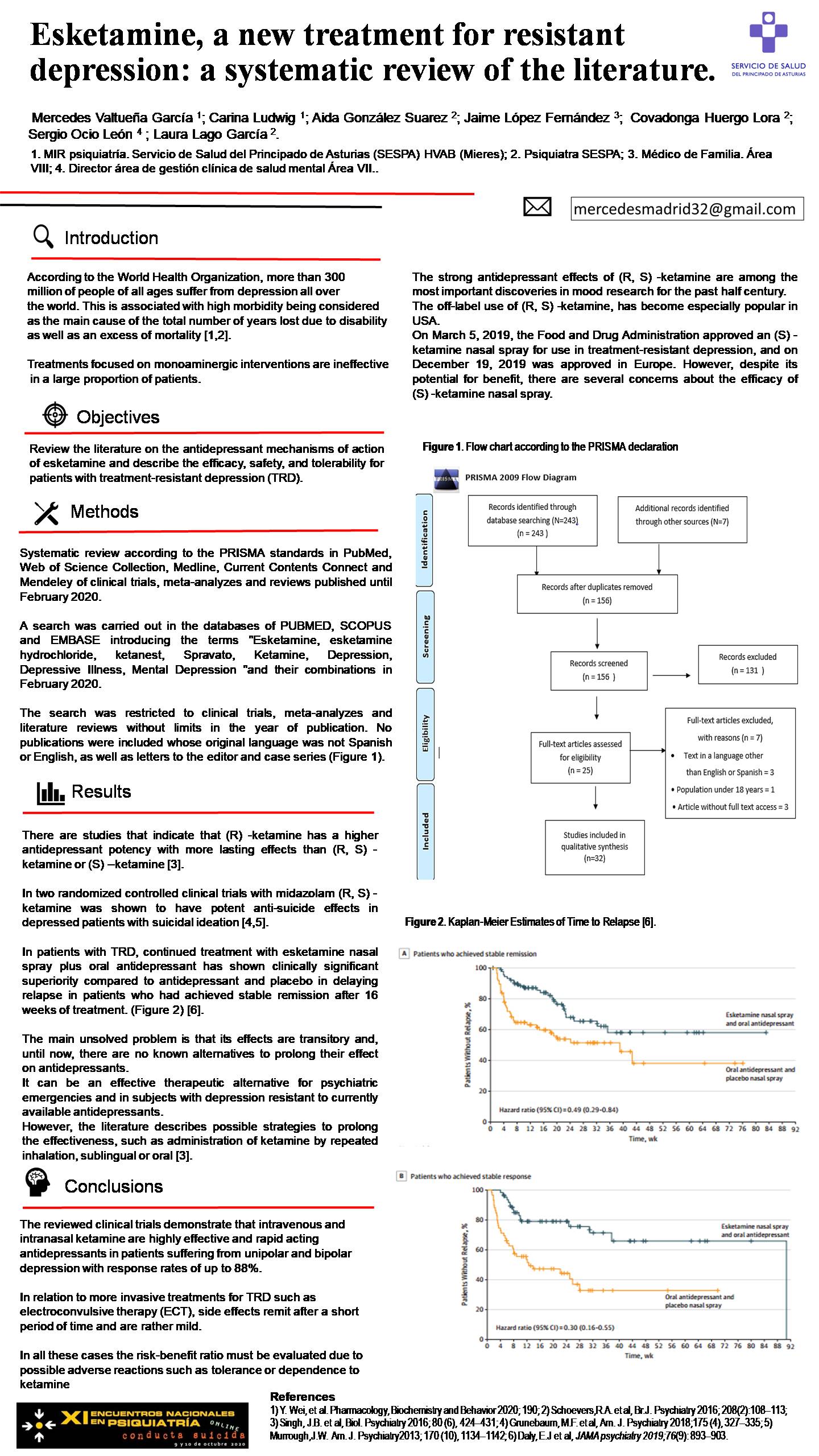
250 articles were obtained, of which publications whose original language was not Spanish or English were discarded, as well as neuroimaging studies. Finally, 32 studies were selected for qualitative analysis.
Conclusions
There are studies that indicate that (R) -ketamine has a higher antidepressant potency with more lasting effects than (R, S) -ketamine or (S) -ketamine. In addition, S-Ketamine treatment allows to achieve a significant remission of suicidal ideation.
The main unsolved problem is that its effects are transitory and, until now, there are no known alternatives to prolong their effect on antidepressants. Currently it can be an effective therapeutic alternative for psychiatric emergencies and in subjects with depression resistant to currently available antidepressants.
However, the literature describes possible strategies to prolong the effectiveness, such as administration of ketamine by repeated inhalation, sublingual or oral [3].
In conclusion, esketamine seems to be a new milestone of pharmacological intervention for the treatment of depression. In all these cases the risk-benefit ratio must be evaluated due to possible adverse reactions such as tolerance or dependence to ketamine
References
1. Fava M.Diagnosis and definition of treatment- resistant depression..Biol Psychiatry.
2003;53:649–659.
2. World Health Organization Media Centre.Depression (factsheet).March22,2018
3. Schoevers,R.A.,Chaves,T.V.,Balukova,S.M.,aanhetRot,M.,Kortekaas,R.Oral ketamine for the treatment of pain and treatment-resistant depression .Br.J. Psychiatry.2016;208(2):108–113.
QBgCfMpngVWjPwjA
tMkLqZOSDgnycMCSVVlUrGF